

August 12, 2026
The SOP That Governs Every SOP
In pharmaceutical business, management maturity is measured by how quickly a company can update its own rules when regulation, markets and operating conditions change. By Oleksandr Pinchuk, Business Development Director, Sona-Exim
Scroll down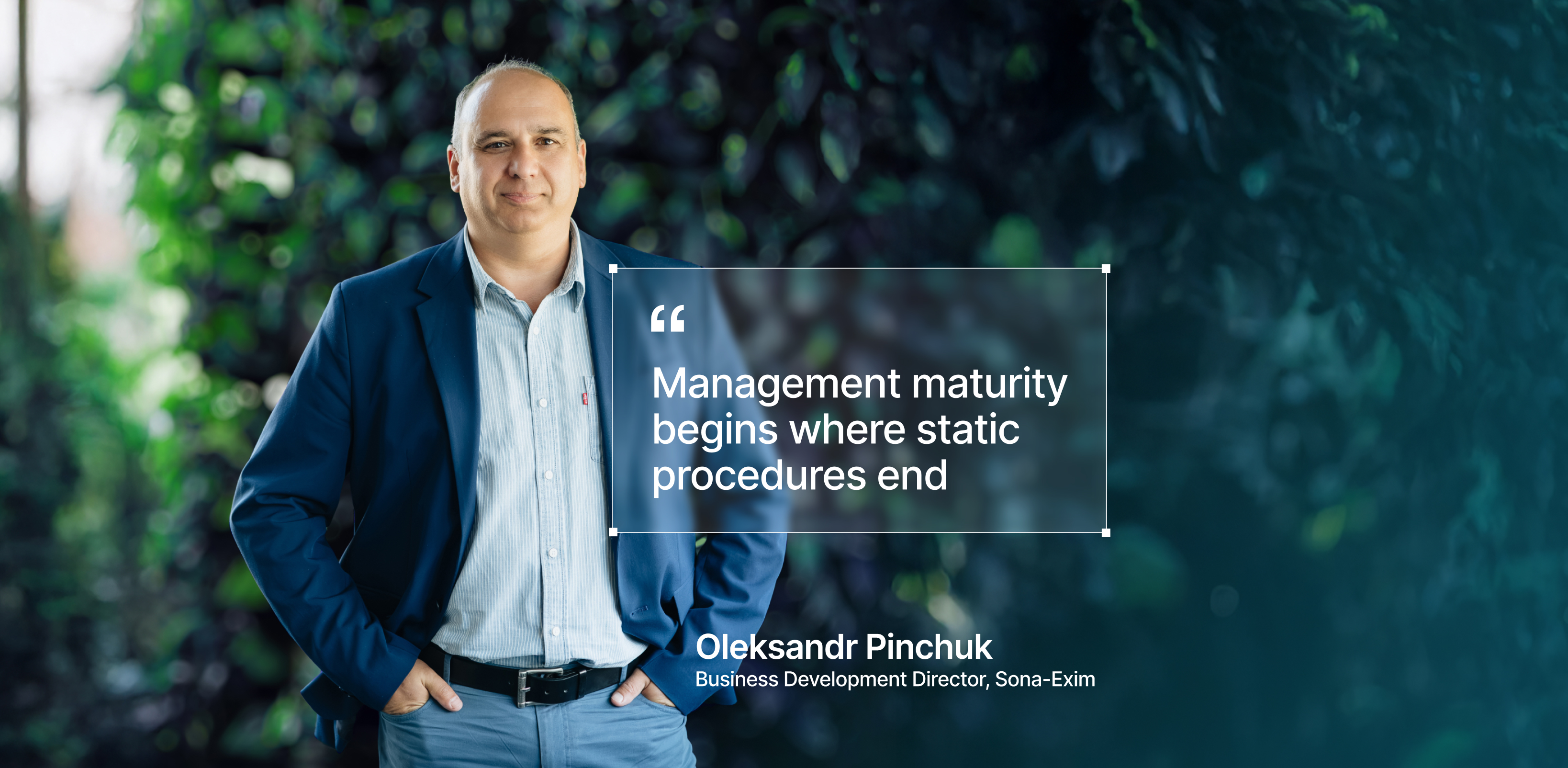
Many companies believe that operational discipline begins with writing more standard operating procedures. The logic seems reasonable: document every process, assign every step, store every template, and the system will eventually run with greater control and predictability.
The result is often an impressive library of SOPs and a reassuring sense of order. Yet one question remains: will that system still work when conditions change faster than the documents themselves?
In pharmaceutical business, this question is impossible to ignore. Regulation evolves continuously. Registration, labelling and serialization requirements shift across markets. Partners revise commercial terms. Suppliers face shortages. Manufacturing sites undergo audits. Commercial teams need new products faster than traditional development cycles can provide them.
A management system proves its value under these conditions. Calm periods show whether procedures exist. Turbulence shows whether the company can still make the right decisions, preserve control and adapt without losing speed.
A procedure is only one layer of the system
I often compare a mature management system to a modern aircraft. During a smooth flight, passengers barely notice the thousands of systems operating around them. Their real value becomes visible during turbulence, when automation, backup mechanisms and clear response algorithms protect the integrity of the flight.
The same principle applies inside a company.
An SOP explains how a specific process should be performed. It rarely answers the wider management questions:
- Who owns the process?
- Who evaluates whether it is still effective?
- Who reacts when regulation changes?
- How is the procedure updated without disrupting the business?
- How are employees trained on the new version?
- How is implementation verified?
A company can have dozens of detailed procedures and still lack a functioning management system.
That is why mature organizations establish governance for the procedures themselves. In practical terms, they create an SOP for SOPs.
What an SOP for SOPs actually controls
An SOP for SOPs governs the full lifecycle of every standard operating procedure: creation, review, approval, employee training, implementation, monitoring, revision, archival and cancellation.
At first glance, this may sound like another layer of bureaucracy. In reality, it is the mechanism that turns separate documents into an integrated operating system.
Without that mechanism, an SOP can remain formally valid while becoming operationally obsolete. Employees may continue following an approved process that no longer reflects regulation, market conditions or business priorities.
With proper governance, every procedure has an owner, a review cycle and a clear route for change. Updates become controlled management actions rather than isolated reactions.
A Business Development example
Consider a typical request in pharmaceutical Business Development.
The commercial team asks us to identify a new product for Ukraine and Kazakhstan. The Business Development team opens the relevant SOP and follows the approved sequence: market analysis, preparation of a technical request, manufacturer search, NDA execution, dossier review, preliminary product assessment, financial modelling, risk evaluation and presentation to the Investment Committee.
The process appears complete.
Then Kazakhstan changes its requirements for the classification of medical devices. A group of products can no longer follow the previous registration route.
A company operating only through the product-search SOP may continue using an outdated algorithm. The procedure still exists. The team may still follow it correctly. Yet the outcome is already compromised because the underlying assumptions have changed.
A governed system reacts differently.
The regulatory team communicates the legislative update. The process owner initiates a review. The company assesses the operational impact. The SOP and its connected templates are revised. Employees receive training. New control points are added to the CRM. Implementation is monitored, and an internal audit confirms whether the new version works in practice.
The change moves through the organization with traceability, ownership and control.
That is the point at which a documented process becomes a management system.
Management maturity is visible in the speed of adaptation
The number of procedures tells us very little about the maturity of a company.
The stronger indicator is the company’s ability to keep those procedures relevant as the operating environment changes.
In international pharmaceutical organizations, every critical process usually has a designated Process Owner. The responsibility extends beyond executing the current procedure. The owner monitors performance, identifies weaknesses, evaluates risk and improves the process over time.
This changes the nature of the SOP. It becomes an active management instrument rather than a static file waiting for its next formal review date.
The same logic sits behind the continuous improvement cycle: Plan, Do, Check, Act. Approval is only one stage. A mature procedure must be executed, measured, audited, challenged and improved.
International growth exposes every weakness in the system
This discipline becomes essential when a company expands.
A Business Development function may begin with one market and a limited number of partners. Soon, the geography includes Kazakhstan, Uzbekistan, the Baltic states, Croatia, Slovenia and Greece. The number of manufacturers increases. So does the volume of NDAs, term sheets, contracts, technical requests, registration projects and financial models.
At that scale, even highly capable specialists can begin working differently.
One manager uses an outdated template. Another follows the current procedure. A third relies on personal experience and performs the process in the way that feels most familiar.
Within months, the company may have ten different versions of what was supposed to be one standardized process.
This is how operational fragmentation begins. It slows decisions, increases risk and makes the business dependent on individual memory rather than institutional capability.
A governed SOP system prevents that drift. It keeps templates synchronized, makes current requirements visible and establishes one operating logic across teams and markets.
The real purpose of control
An effective management system constantly checks its own relevance.
It prevents procedures from ageing unnoticed. It reduces the risk of employees working under outdated rules. It identifies when a process is losing efficiency. It protects the company from becoming dependent on a small number of individuals who carry critical knowledge in their heads.
This is the central idea behind an SOP for SOPs.
Its purpose is not to create more paperwork. Its purpose is to preserve manageability as the company grows, the market changes and external pressure increases.
The most resilient pharmaceutical companies are built on systems capable of renewing themselves. Their processes evolve with regulation, withstand market disruption and support international expansion without sacrificing consistency.
So, can a management system work in any weather?
Yes, provided the company governs both its processes and the rules that define how those processes operate.
At that point, an SOP becomes part of a living management system: one that learns, adjusts and protects the business through every stage of growth.